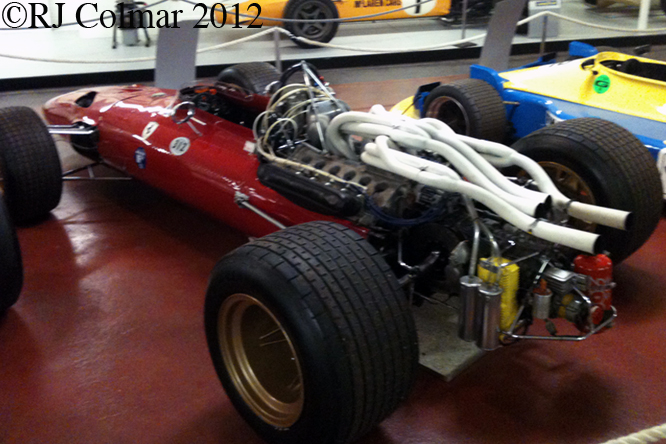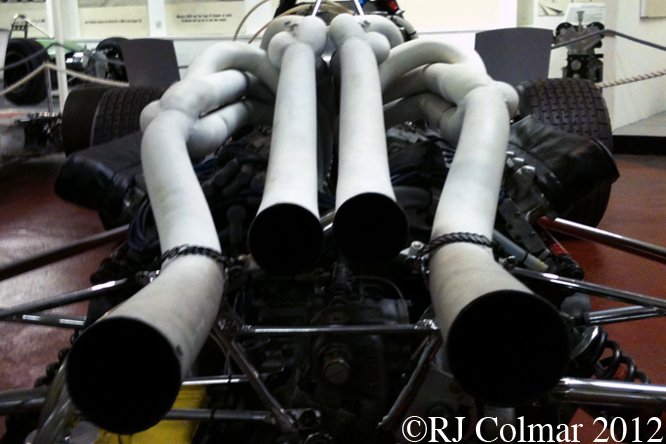
Tag Archives: Amon

Class But No Championships – Ferrari 312P #0872

For 1968 a new championship was announced for 3 litre / 183 cui prototype sports cars called Championnat Internationale des Marques. A lack of entries for the series led to a late change in the rules which extended the life of the Ford GT40 and Lola T70 for four years and inadvertently gave Ferrari and Porsche a window in which to build the 512S and 917 models respectively.
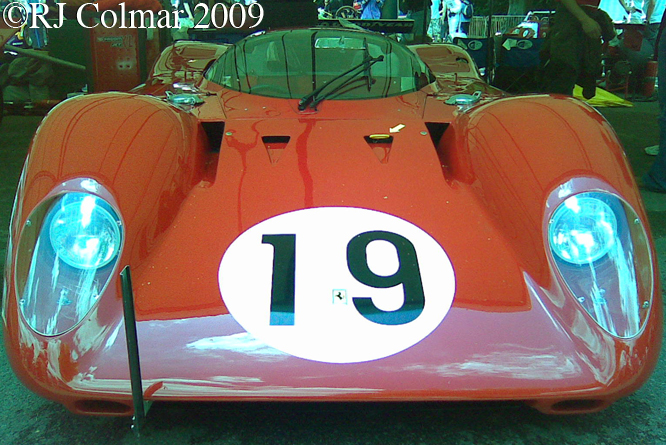
Ferrari 312P, Goodwood Festival of Speed

For 1969 Ferrari built it’s first 3 litre / 183 cui prototypes using detuned V12 engines from it’s Formula One programme. In all three 312P’s were built by the factory two open top Spyders and the closed top Berlinetta chassis #0872 featured today.

Although the 312P’s are not remembered as being a match for the Porsche 908’s that ran in the same class they did take several class wins when they finished. #0872 won it’s class at Daytona in 1970, 4th overall, driven by Mike Parkes and Sam Posey, and again at Sebring driven by Parkes and Chuck Parsons who replaced Posey.

In 1971 #0872 appeared with Spyder bodywork and Luigi Chinetti and Garcia Veiga took another class victory at Daytona in the 24 hour marathon.

Ferrari 312P, Goodwood Festival of Speed

When #0872 was first raced by Chris Amon and Peter Schetty at Le Mans in 1969 carrying the #19 the car was a last minuet substitute for chassis #0868, which had crashed a couple of weeks earlier at Monza, and was raced with the #0868 identity due to the difficulty in getting the correct international travel documents for #0872 ready in time.

Chris Amon hit a fuel tank from the fatally disintegrated Porsche 917 of John Woolfe on the opening lap, causing #0872 to catch fire and it’s subsequent retirement without injury to the New Zealander.
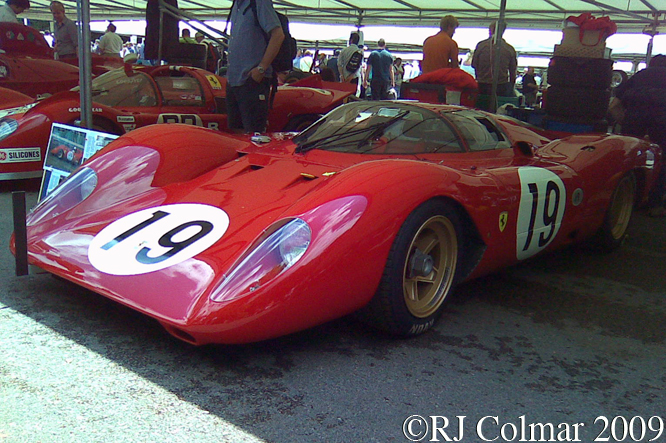
Ferrari 312P, Goodwood Festival of Speed

In the spring of 1971 #0872 was dismantled, the engine, transmission, suspension and steering were subsequently fitted to a brand new chassis known as the Chinetti Special / Flying Shingle, a car which did not finish at Daytona in 1972 and manged 9th overall 6th in class at Le Mans in 1974 driven by Jean-Claude Andruet and Teodoro Zeccoli.

In 1980/81 all the parts of #0872 were reunited along with it’s original Berlinetta body, and the Flying Shingle has been reconstructed without any of the original parts from #0872.

Thanks for joining me on this “Class But No Championships” edition of “Gettin’ a li’l psycho on tyres”, I hope you will join me again tomorrow. Don’t forget to come back now !

Share

Three Continent Veteran – Ferrari Dino 166/246 #0004

Last week I looked at a FIAT Dino Spider that was part of a programme to homologate (legitimise) Ferrari’s V6 Dino engine, which had impressed many when fitted to the 166 P sportscar in 1965, for the second tier European Formula 2 Championship which mandated 1.6 litre / 97.6 cui motors with a maximum of 6 cylinders based on production blocks of which at least 5000 examples had been cast.

Ferrari, Dino, 166/246, Donington Museum

Today’s featured car is the second of seven Ferrari Dino 166’s, that were built to compete in the European Formula 2 Championships from 1967 to 1969. It was first raced in 1967 by Chris Amon at the Hockenheimring in a Formula 2 race in which it did not finish. #0004 was then used by Chris in the Tasman series run in Australia, New Zealand and Tasmania where engines of up to 2.5 litres / 152 cui were mandated.

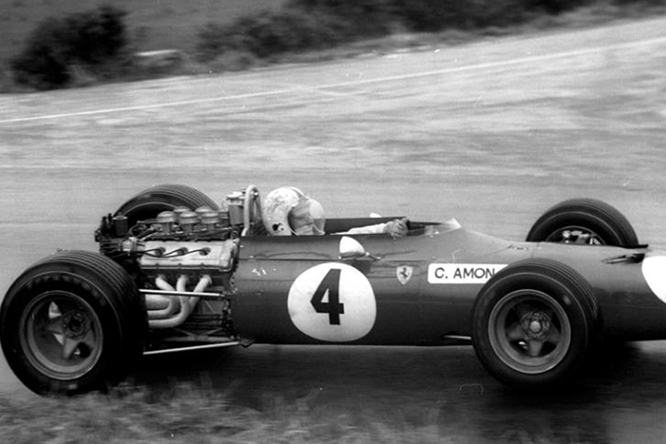
Chris Amon, Ferrari, Dino, 166/246, Longford, Tasmania

(Chris Amon, Ferrari 166/246 #0004, Longford, Tasmania, March 4th, 1968, Copyright Rod Mackenzie 1968)

Ferrari sent two motors ‘down under’ one a 2.4 litre / 146 cui V6 with three valves per cylinder and the second with 4 valves per cylinder. Amon won the first two races of the 1968 Tasman series in New Zealand and scored two further second place and two 4th place finishes to be in with a mathematical shot at the championship going into the final round but Jim Clark was not to be denied and Amon finished second to the Scotsman in the final championship standings. Chris is seen in Rod Mackenzie’s photo above driving to a 7th place finish in the last race of the season at Longford, Tasmania. Without doubt this photo represents the furthest point south in a photograph ever published on ‘Gettin’ a li’l psycho on tyres’.

Ferrari, Dino, 166/246, Donington Museum

Back in Europe #0004 was returned to Formula 2 specification with a longer wheel base and an upgraded 225 hp 1.6 litre / 97.6 cui motor with four valves per cylinder in place of the original F2 spec 3 valves per cylinder. On October 13th 1968 Ernesto “Tino” Brambilla scored a memorable victory, from an 8th place start, at the Hockenheimring by putting all four wheels on the grass as he overtook his team mate Derek Bell and Henri Pescarolo driving a Matra on the last lap. Brambilla’s greatest moment was also Ferrari’s first Formula 2 victory since Wolfgang “Taffy” von Trips class win in the 1960 Italian Grand Prix.

Ferrari, Dino, 166/246, Donington Museum

Brambilla then drove chassis #0004 to two further consecutive victories at Vallelaguna in Italy and Buenos Aires, Argentina where the #0004 was being used in the South American Temporada F2 series. Andrea de Adimich driving another Dino 166 took three victories in the remaining ’68 Temporada Series races to win the Championship while Tino recorded three DNF’s (Did Not Finish). Tino drove the car four more times in Europe in 1969 recording a best 4th place at Jarama in Spain.

Ferrari, Dino, 166/246, Donington Museum

Chris Amon often considered by everybody except himself to be the unluckiest man in Grand Prix racing went back to compete in the Tasman championship with 166/346 chassis #0008 in 1969. Taking five wins from ten races along with four podium finishes Chris sealed the deal with the Dino at the second time of asking. Fellow New Zealander Graeme Lawrence repeated the Tasman Championship winning feat in 1970 using the same #0008 chassis Chris had used the year before.

Rob Hall, Ferrari, Dino, 166/246, Tasman Revival, Eastern Creek Internaltional Racway

(Rob Hall, Ferrari 166/246 #0004, Eastern Creek International Raceway November 2010, Copyright Rod Mackenzie 2010)

Everett Anton Singer owned #0004 from the mid 1980’s to the late 1990’s during which time the car won it’s class twice in Concours d’Elegance events at Atlanta (’89) and Watkins Glen (’90). #0004, now owned by Graham Adleman has revisited the Antipodes twice since it’s heyday. With Rob Hall drove #0004 to win the 2008 Tasman Revival meeting at Eastern Creek International Raceway just outside Sydney Australia and just getting pipped by a a 3 litre 183 cui Lotus 49 in 2010 Tasman Revival meeting at the same venue. The Tasman Revival will be taking place again this year further details of the event can be found on this link.

My thanks to Rod Mackenzie for the use of his photographs and to everyone who contributed to the “1968 Ferrari Tipo 166 Dino Formula II” thread at The Nostalgia Forum where more photo’s of #0004 have been posted, particular thanks to Alan Cox for identifying #0004 and ellrosso of the OldRacePhoto.com website which gives viewers a fascinating insight into racing down under over a period spanning several decades.

Thanks for joining me on this “Three Continent Veteran” edition of “Gettin a li’l psycho on tyres”, I hope you will join me again tomorrow. Don’t forget to come back now !
Share

On Luck – Ferrari 312 #0007

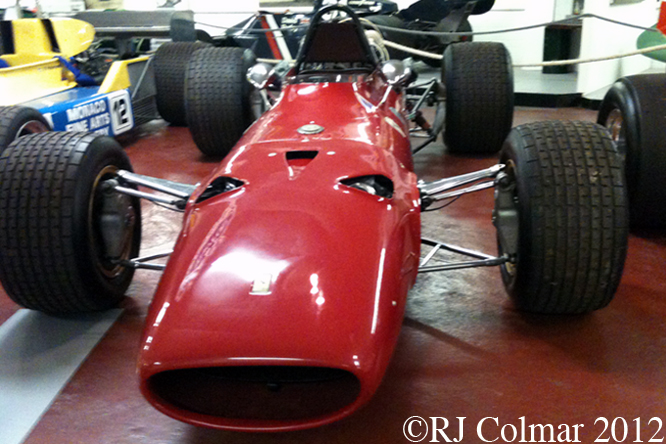
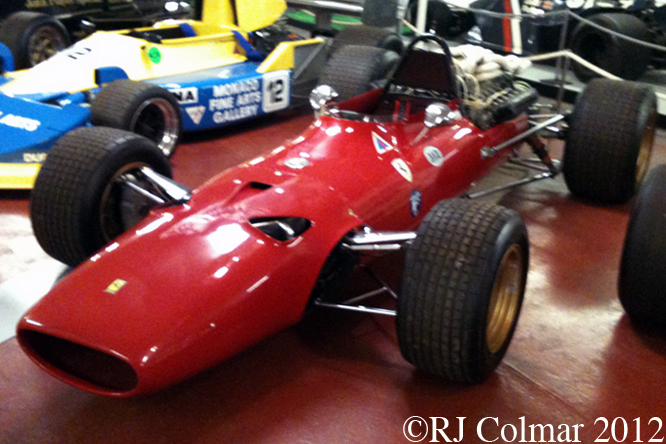
With the introduction of the 3 litre / 183 cui Formula One regulations in 1966 Ferrari not only found themselves unprepared they were also desperately underfunded in part due to Enzo’s withdrawal from a deal with Ford and in part because Ferrari had to spend a lot of money on his sports car programme to try in vane to stop a Ford steamroller from whipping him off the Le Mans scoreboard.

Ferrari 312/67, Donington Grand Prix Collection

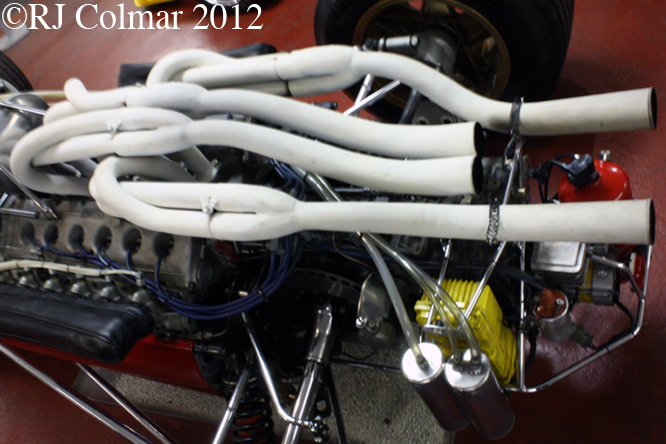
In order to maintain a presence in Formula One under the new 3 litre rules a 24 valve 3.3 litre 201 cui V12 design from the Ferrari 275P2 sports car programme was modified to the meet lower 3 litre / 183 cui engine capacity regulations and installed into the first of a long line of Grand Prix Ferrari’s designed by Mauro Forghieri.

Ferrari 312/67, Donington Grand Prix Collection

Despite the heavy old sports car engine in the back Ferrari were one of the few teams to have an engine of the correct size when the 1966 season got under way many teams were giving away between 45 cui and 90 cui in engine capacity just to make the grid.

Ferrari 312/67, Donington Grand Prix Collection

1964 World Champion John Surtees started and 1966 as Ferrari’s team leader but he fell out with Ferrari’s management after winning the Belgian Grand Prix and before starting the Le Mans 24 hours, however Ferrari still finished the season a respectable 2nd in the Constructors Championship thanks to a win in Italy and a couple of second place finishes, beating John Surtees new Cooper Maserati team by a single point despite missing a couple of races.

Ferrari 312/67, Donington Grand Prix Collection

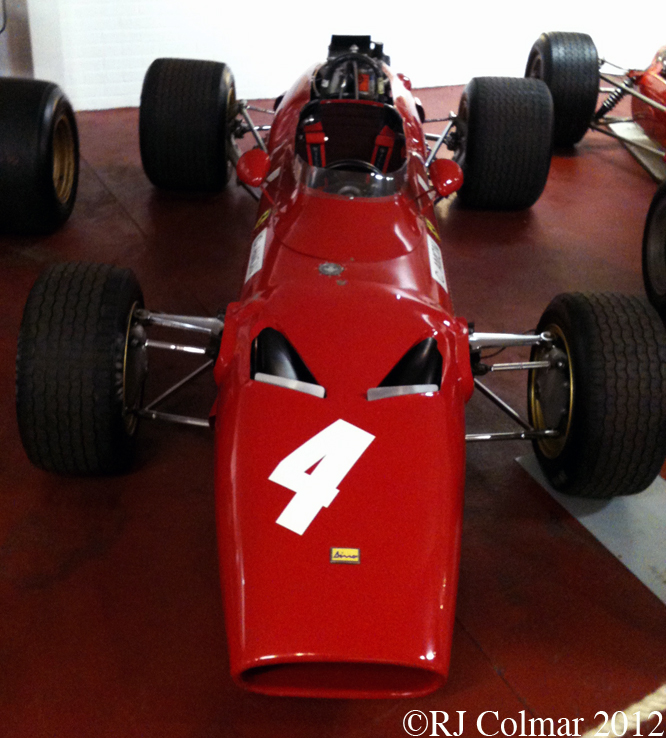
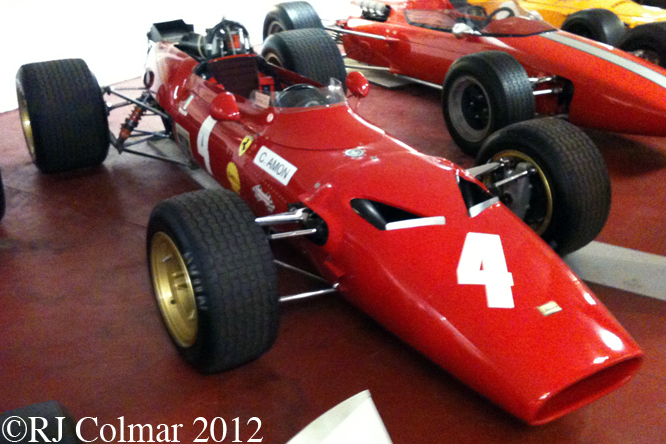
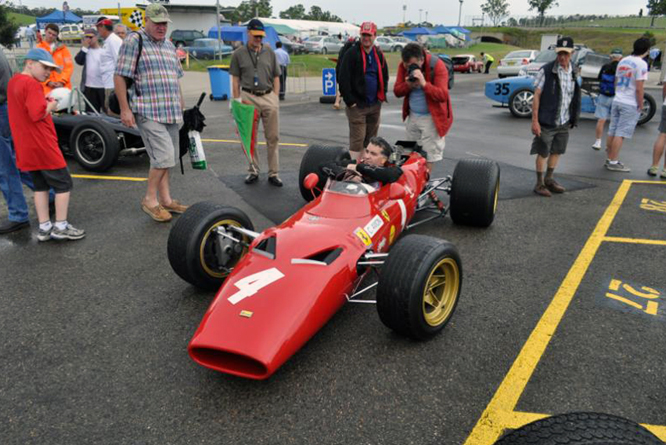
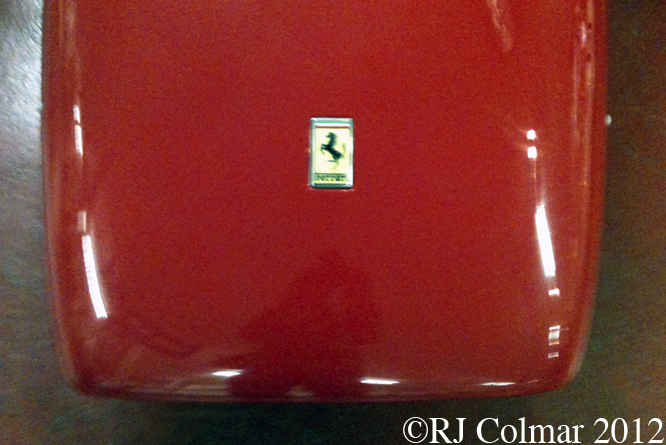
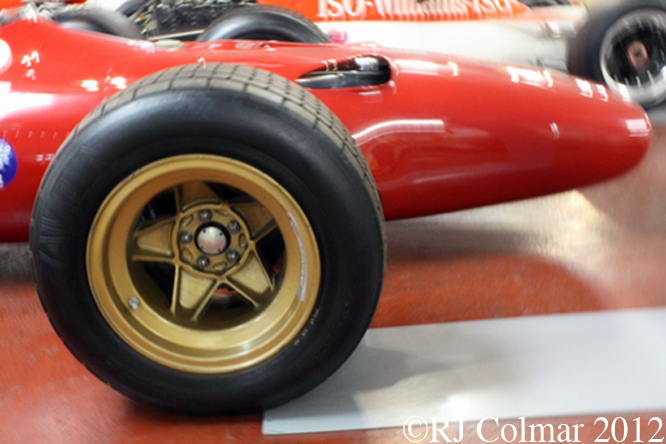
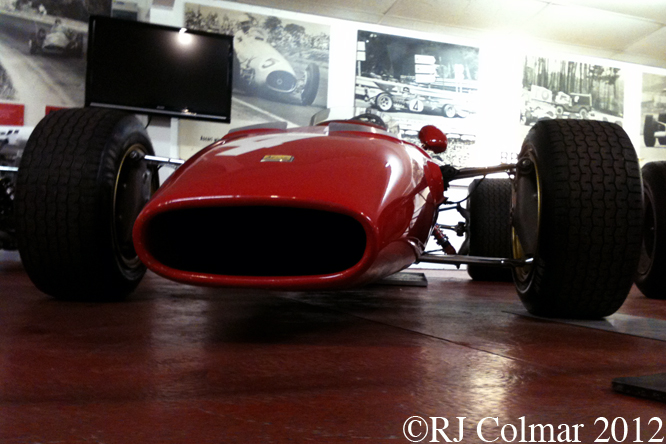
For 1967 the 1966 cars were improved and chassis 0007, seen here recently at the Donington Grand Prix collection, was the last of 4 new Grand Prix cars Ferrari built in 1967, Chris Amon was hired to drive alongside Lorenzo Bandini, at Monaco Bandini qualified 2nd but an fiery accident during the race proved fatal and Chris Amon could only manage a string of four seasons best 3rd place finishes on the way to fifth in the championship for himself and his team, before taking over chassis #0007 towards the end of the season.

Ferrari 312/67, Donington Grand Prix Collection

In 1968 0007 was used again by Chris Amon and he won pole positions in Belgium and Holland with it but the season was a disaster for the driver who only succeeded in cementing his reputation as the unluckiest driver in Grand Prix racing with a seasons best 2nd place finish, in a newer ’68 spec 312, and a string of 7 retirements from 11 starts.

Ferrari 312/67, Donington Grand Prix Collection

1966 Le Mans winner, with Bruce McLaren in a Ford, Chris Amon never did win a Grand Prix despite starting 5 of his 108 Grand Prix from pole position, he has always maintained that he was lucky simply to have survived what is generally considered to have been the most dangerous period in racing, a point starkly backed up by the stat that 8 of the 24 starters in the 1963 Belgian Grand Prix where Chris made his debut did not see out the decade thanks to accidents at the wheel of racing cars.

Ferrari 312/67, Donington Grand Prix Collection

The last person to drive 0007 in period was future sports car giant Derek Bell who started the non Championship Gold Cup and championship United States Grand Prix in this chassis but did not finish either event.

Thanks for joining me on the ‘On Luck’ edition of ‘Gettin’ a li’l psycho on tyres’, I hope you will join me again tomorrow. Don’t forget to come back now !
Share